14 Oct 2026
5 Dec 2025
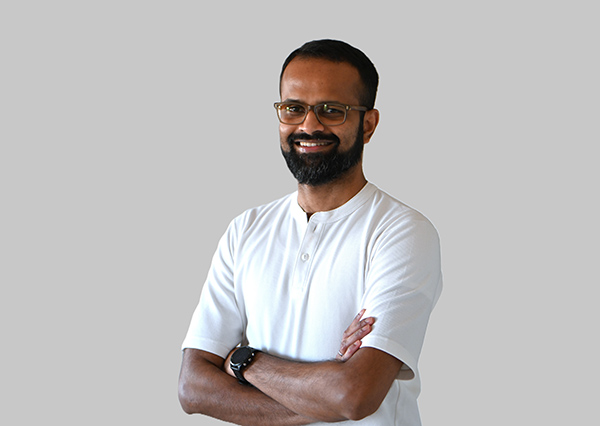
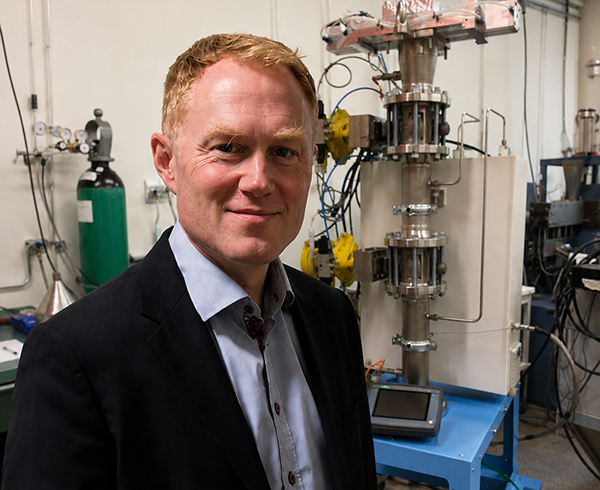
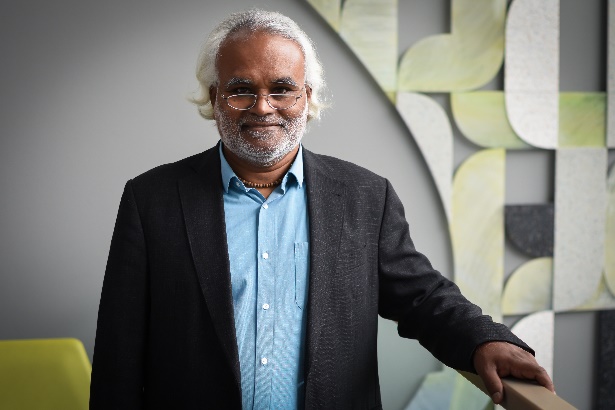
Get to Know Our Guest Professor, Mukundan Thelakkat
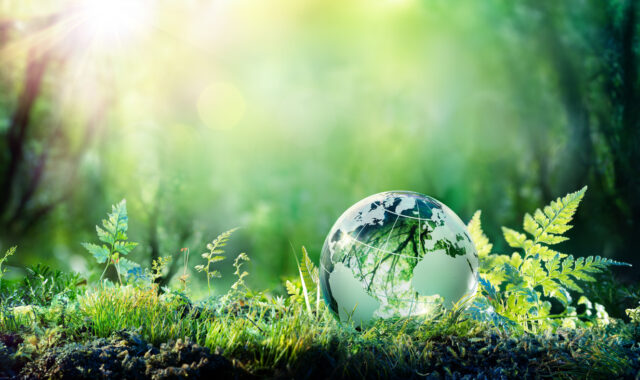
“For us it is important to work with sustainable materials and make sure that we manufacture them employing low-energy processes. We think from the beginning what elements we are going to use -their availability, price, recycling possibilities, etc.”, says Professor Thelakkat.
To further advance its commitment to global research partnerships, WISE operates the Guest Professor (GP) Program, designed to engage with prominent scientists from around the world. On this occasion, WISE is delighted to welcome Professor Mukundan Thelakkat from the University of Bayreuth, who will soon start his term as WISE Guest Professor at Chalmers University of Technology on the first of January 2026.
Mukundan Thelakkat is Professor of Applied Functional Polymers at University of Bayreuth in Germany. Recently, we sat down with him to talk about his research and his activities within WISE as a Guest Professor.
What are your current research field and main research activities?
I’m originally from a small town in Kerala, India. After my Masters studies in Chemistry in Kerala, I earned my PhD at the Institute of Organic and Macromolecular Chemistry at the Friedrich-Schiller University of Jena in Germany. Over the past thirty years, my research has centered on organic semiconductors, particularly on charge generation and transport materials based on conjugated polymers for organic solar cells, along with bioelectronics, including electrochemical transistors, and light-emitting materials for electroluminescence. Additionally, I work on ion transport materials such as solid polymer electrolytes for all solid-state batteries.
My interest in organic bioelectronics developed in the 2010s. During this time, I had intensive collaboration with Olle Inganäs at Linköping University. Further, I came into contact with Magnus Berggren, Simone Fabiano, Alexander Giovannitti and others in Sweden. I worked on understanding mixed ion and electron transport in thin solid polymer films, which are in close contact with aqueous electrolytes and thereof change in morphology and charge transport which make them suitable for applications in electrochemical transistors. I have also carried out research on thin-film organic/hybrid thermoelectric materials, which combine high Seebeck coefficient and electrical conductivity that convert thermal energy into electricity. Here, I have long-term contacts with Christian Müller from Chalmers University of Technology.
Our individual research labs at the University of Bayreuth are supported by joint research units that we call Key-Labs, each concentrating on different technological tasks and levels—for example, processing of thin-films, device engineering and materials design, synthesis and characterization. I coordinate one of these Key-labs; viz. Keylab for Device Engineering. This structure enables us to work across several disciplines and technology-readiness levels, which is crucial for moving ideas forward.
What are the sustainability aspects of your research?
For us it is important to work with sustainable materials and make sure that we manufacture them employing low-energy processes. We think from the beginning what elements we are going to use (their availability, price, recycling possibilities, etc.) Most of our materials we investigate at our lab are earth abundant, non-rare-earth elements, but carbon-based, which can potentially be obtained from renewable sources. When it comes to applications, our work focuses on green energy technologies such as next generation solar cells and batteries to address the challenges of carbon-neutral technologies.
How can Materials Science evolve to address sustainability and the climate change crisis?
Materials science has an important role to play. For example, from the substrates used in devices up to active materials used for charge transport as well as periphery materials used for casing and packaging have to be scrutinized for their carbon footprint, their availability and accordingly replaced gradually. Paper is a promising substrate whose conductivity and transparency can be tailored as needed, and its production process has the potential for substantial reductions in greenhouse-gas emissions. Additionally, AI-assisted screening and research on novel, earth-abundant, non-toxic active materials for electronics and catalysis in addition to recycling and reuse of the present materials can support the sustainability challenges.
What advice would you give to young researchers entering this area?
Perseverance is key. Whatever project you take on, you can be sure it won’t work perfectly at the start. You need to stick with it, dig deeper into the research, and really understand why it’s not working so you can figure out how to make it work.
Teamwork also matters a lot. Surround yourself with people from different backgrounds (biology, physics, chemistry and engineering) and build an interdisciplinary team. And don’t be afraid to step outside your own field—if you’re a chemist, spend some time with physicists. Seeing your problem from a different perspective can make a huge difference.
And always keep sustainability in mind. Don’t choose to work with materials that have major availability issues. Aim for solutions that make sense in the long run.
Brief Bio:
- 2006– present Professor of Applied Functional Polymers at University of Bayreuth, Germany
- 2012-present Director Board, Bavarian-Indian Cooperation Centre, Bavaria
- 2012 Distinguished Scientist of CSIRO, Australia and Sabbatical at CSIRO Melbourne
- 2004 Research stay at General Electric, Niskayuna, USA
- 2000-2004 Scientific Assistant and Habilitation in Macromolecular Chemistry, University of Bayreuth
- 1995-1999 Guest scientist and Scientific Assistant at Macromolecular Chemistry, University ofBayreuth
- 1993 – 1994 Postdoctoral Scientist at BASF AG, Ludwigshafen, Germany
- 1992 – 1993 Lecturer in Chemistry at NSS College, Manjeri, Calicut University, India
- 1988 – 1992 Research Assistant at Institute of Organic and Macromolecular Chemistry, Universityof Jena, Germany
- 1980 – 1988 Lecturer in Chemistry at NSS Colleges under Calicut and Kerala Universities, Kerala, India
- 1988-1992 PhD in Chemistry, Institute of Organic and Macromolecular Chemistry, University of Jena, Germany.