21 Aug 2026

25 Sep 2026
From Birch Leaves to Bright Ideas: Green Nanodots for a More Sustainable Future
What if birch leaves could help power tomorrow’s electronics or improve medical technologies?
At Umeå University, researchers are turning renewable plant materials into tiny carbon-based nanomaterials that could make future technologies both greener and more sustainable.
A Greener Alternative to High-Tech Materials
Nanomaterials play a vital role in modern technologies, from LED displays and solar cells to biomedical imaging. However, many of these advanced materials are produced from fossil-based chemicals or rely on non-renewable resources.
Researchers in The Green Nanodots Group at Umeå University are developing sustainable alternatives by producing carbon dots, tiny light-emitting nanomaterials from renewable biomass such as plant materials. These are tiny particles made primarily of carbon, typically less than ten nanometres across around 10,000 times smaller than the width of a human hair. Despite their size, carbon dots have remarkable properties. They can absorb and emit light in different colours, making them useful in applications ranging from energy-efficient lighting and sensors to medical imaging and next-generation electronics.
Unlike many conventional nanomaterials, carbon dots can be produced from renewable biomass such as leaves, wood, and agricultural waste.
“Nature offers an incredible diversity of renewable resources. Our goal is to understand how these natural materials can be transformed into high-performance nanomaterials for future technologies,” says Jia Wang, leader of The Green Nanodots Group at Umeå University.
Understanding How Green Nanodots Form
Although carbon dots can be produced from renewable resources, scientists still do not fully understand how they form or why different raw materials produce different properties.
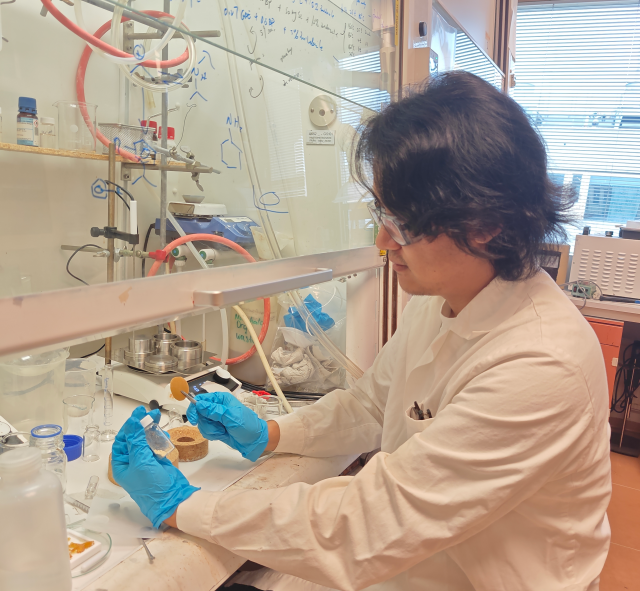
To answer these questions, the research team combines material synthesis with advanced spectroscopy and structural analysis. By studying how the chemical composition of different plants affects the structure and optical properties of carbon dots, they are building the knowledge needed to design these materials more precisely.
Rather than relying on trial and error, this understanding could make it possible to create carbon dots with tailored properties for specific applications.
“To develop truly sustainable nanomaterials, we need to understand them at the molecular level. That knowledge allows us to design materials with the properties we want,” says Jia Wang.
Learning from Nature
The researchers have investigated carbon dots made from several types of plant biomass and have begun linking specific chemical building blocks to the properties of the resulting nanomaterials.
One particularly exciting result comes from an abundant local resource: birch tree leaves. The team has successfully produced three different types of carbon dots from the leaves, which have already been demonstrated in a solution-printable light-emitting device and an all-bio-based random laser.
“Seeing a local natural resource like birch leaves transformed into advanced photonic materials has been one of the highlights of our research,” says Jia Wang.
Building a More Sustainable Future
Carbon dots have already shown promise in applications including light-emitting devices, photonics, and biomedicine. Because they can be made from renewable biomass, they could reduce dependence on fossil-based materials and contribute to more sustainable supply chains.
The research is still at the laboratory stage, but through collaborations with partners in Sweden and abroad, the team is exploring new applications while deepening its understanding of these promising materials.
“Our biggest challenge is understanding exactly how carbon dots form and what their molecular structure looks like. Solving that puzzle will help us develop even better sustainable nanomaterials and bring them closer to real-world applications,” says Jia Wang.