15 Oct 2026
15 Oct 2026
Can Greener Electronics be enabled by Superconducting Materials?
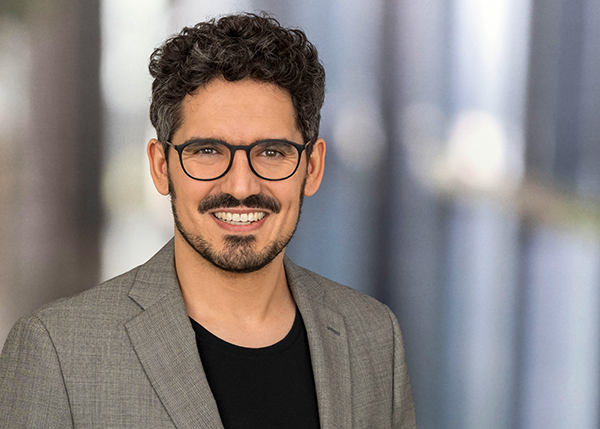
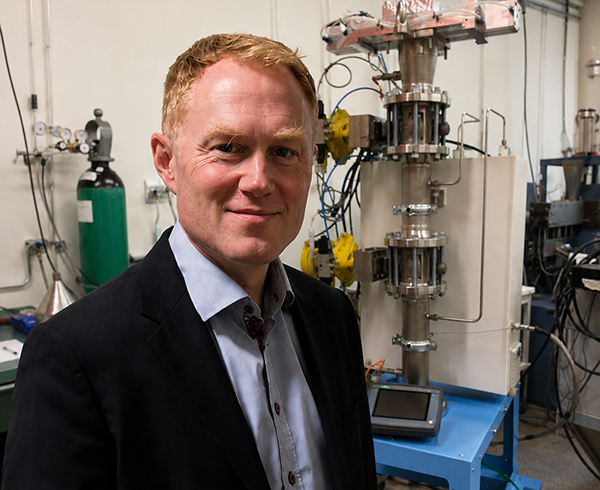
“Semiconductors consume a lot of energy, and we are approaching the limits of how much energy can be saved with the technology based on those materials. In principle, superconductors could allow us to increase information density while also improving energy efficiency”, says Prof. Babaev.
From streaming movies and storing photos in the cloud to using artificial intelligence, more and more of our daily lives depend on computers. Some estimates suggest that data centers powering our digital world could consume as much as 13% of global electricity by 2030. Making computing more sustainable will therefore require radically more energy-efficient technologies. One promising solution is superconducting electronics, which could dramatically reduce the energy needed for future computing. A discovery reported in the journal Science by a team of researchers from China, France and Sweden reveals unusual magnetic structures inside a superconductor that could inspire new ways to store and process information.
Superconductors are materials that, under certain conditions, often very low temperatures, can conduct electricity without resistance. They normally push magnetic fields out. However, magnetic fields can sometimes enter through tiny whirlpools of electrical current known as vortices. Each vortex usually carries a fixed amount, or “quantum”, of magnetic flux.
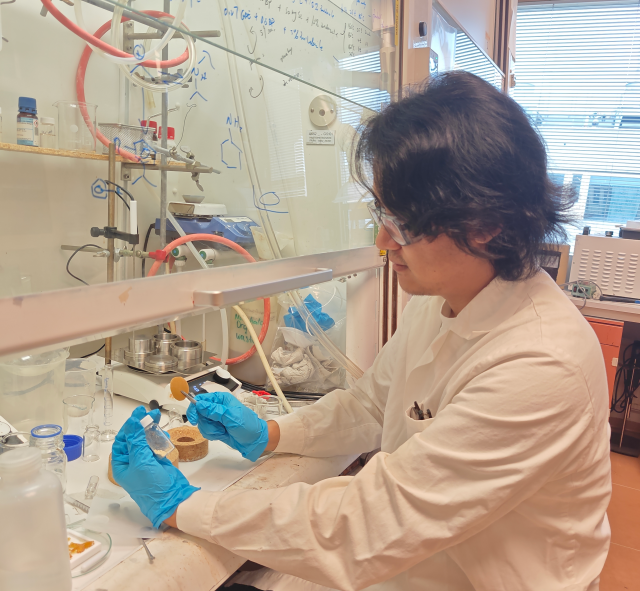
Using a scanning tunnelling microscope, the researchers at T. D. Lee Institute at Shanghai led by Hong Ding examined the surface of the iron-based superconductor KFe₂As₂. They observed signs that a vortex’s central core can split into separate cores associated with fractions of the usual magnetic-flux quantum. This phenomenon, known as vortex fractionalization, was first predicted theoretically in 2002 by one of the authors of the study, Professor Egor Babaev from KTH Royal Institute of Technology and WISE-affiliated researcher. At that time, Babaev suggested that that can be possible if a material contains several coupled superconducting bands: a vortex shared by these components can separate into fractional parts.
—We are revisiting a 70-year-old concept, pioneered by Lars Onsager and Richard Feynman, whose theory had one vortex core per flux quantum. Only now the team at T. D. Lee Institute has been able to design an experiment that allowed us, for the first time, to observe the violation of the relationships that Onsager-Feynman and Abrikosov theories predicted. Together with WISE student Igor Timoshuk, we provided theory support and numerical modelling, says Egor Babaev.
Why might this matter for computers?
Superconducting circuits can already use tiny packets of magnetic flux to represent and process information with very little energy. Fractional vortices offer additional physical states that researchers could explore as carriers of information. If scientists learn to create, move and detect them reliably in small devices, they might enable new designs for memory or computing circuits. That is a possible future application, rather than a result demonstrated in this study. The discovery’s contribution is fundamental: it expands our understanding of electronic flows in superconductors, giving scientists another starting point for developing computers that waste less energy as heat.
—Semiconductors consume a lot of energy, and we are approaching the limits of how much energy can be saved with the technology based on those materials. In principle, superconductors could allow us to increase information density while also improving energy efficiency, continues Prof. Babaev.
The original article “Observation of quantum vortex core fractionalization and skyrmion formation in a superconductor” by Y. Zheng, Q. Hu, X. Yu, H. Ji, I. Timoshuk, J. Garaud, H. Xu, Y. Li, Y. Gao, X. Lu, V. Grinenko, E. Babaev, N. F. Q. Yuan, R. Wu, B. Lv, C.-M. Yim and H. Ding published in Science 2, 80-84 (2026) can be found at
https://www.science.org/doi/10.1126/science.ads0189
To know more about Prof. Egor Babaev’s research in WISE please visit: