12 Jun 2026
From Molecules to Milk Cartons: Exploring New Paths Toward More Sustainable Packaging
Imagine opening a juice box made from materials designed with deeper scientific insight into how they behave at the smallest scales.

3 Dec 2024
-While XPS is straightforward to use for metals, it poses profound challenges for insulators, which can lead to inaccurate spectra interpretation. The exponential growth in XPS publications has also increased the risk of dissemination of potentially erroneous results. This is a serious concern because scientific progress depends on reliable and reproducible data, say Profs. Greczynski and Hultman from Linköping University.
In a Perspective article published in Nature Reviews Materials in November 2024, Professors Grzegorz Greczynski and Lars Hultman from the Department of Physics, Chemistry, and Biology (IFM) at Linköping University discuss critical insights into the XPS technique and emphasize the urgent need for new referencing standards in XPS.
In the 1950s, Kai Siegbahn and his research group at Uppsala University pioneered precise methods for analyzing the energy of electrons emitted from atoms, molecules, or radioactive materials when excited by X-rays. In 1954, they recorded the first high-energy-resolution XPS spectrum of cleaved sodium chloride and a few years later they reported the first observation of the chemical shift in copper oxide. Siegbahn’s groundbreaking work in transforming XPS into a robust analytical tool earned him the Nobel Prize in Physics in 1981.
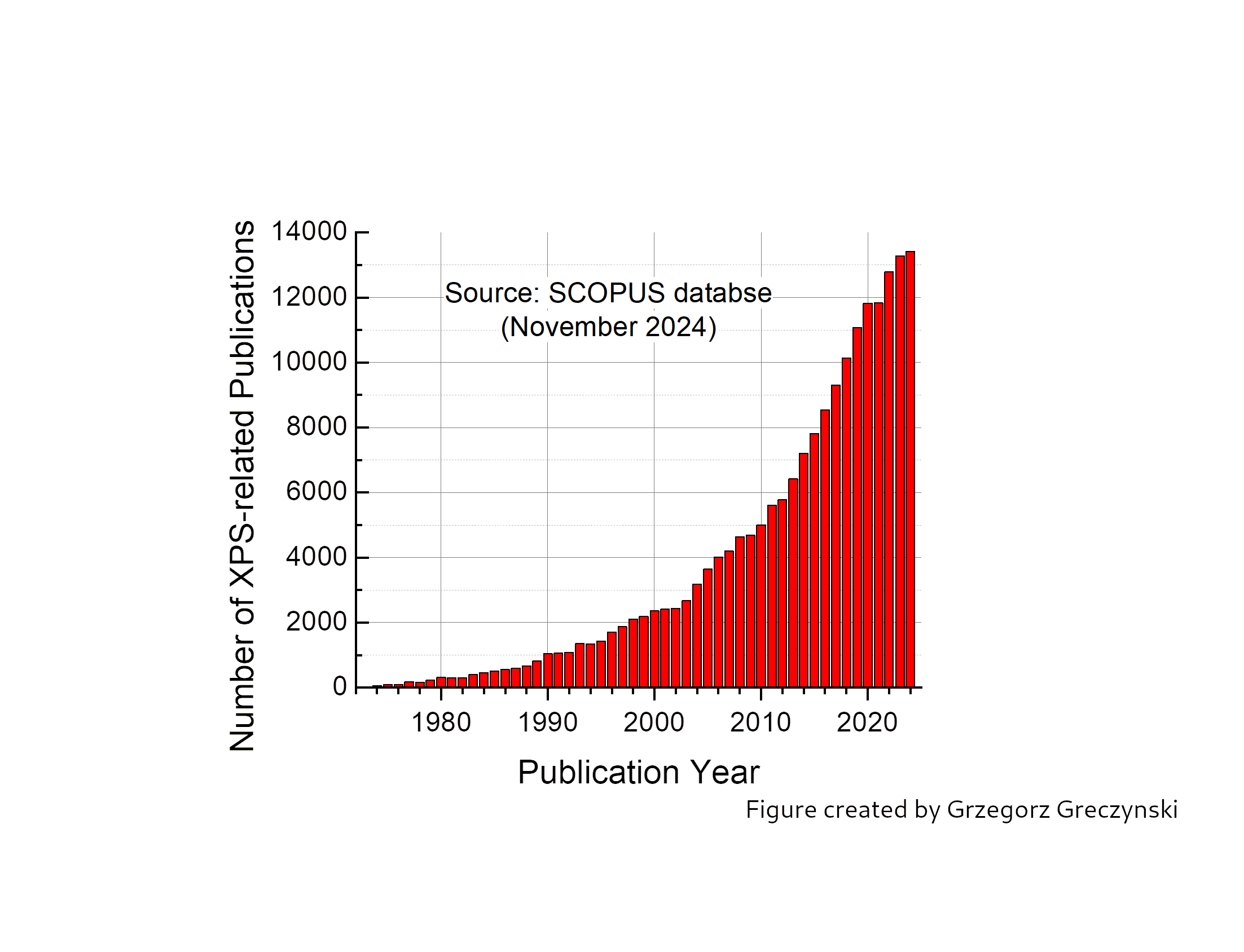
While XPS is straightforward to use for metallic systems, it poses profound challenges for insulating materials. In insulating materials, positive charge buildup during photoemission can cause uncontrolled shifts in binding energies of spectral peaks, leading to inaccurate spectra interpretation. Unlike metals, where the issue is essentially absent due to high electrical conductivity, no universal solution exists for insulators. This was already pointed out in the early days of XPS. The exponential growth in publications using XPS in recent years (see figure) has also increased the risk of potentially erroneous results being disseminated. This is a serious concern because scientific progress depends on reliable and reproducible data.
-Of course, in the pioneering days, more than fifty years ago, the resolution of XPS was much lower than that of today’s spectrometers, and therefore such errors were considered negligible. However, today, with instruments offering an order of magnitude better resolution than in the 60s, such errors can lead to misleading results and contribute to an unacceptably large spread in the binding energy values reported for the same chemical state, explains Lars Hultman, Professor at Linköping University and WISE researcher.
The persistence of referencing problems stems partly from a cultural tendency to follow established routines and equipment manufacturer instructions without revisiting foundational assumptions. Professor Hultman emphasizes the need for special attention and revision of energy referencing in XPS to protect the quality of produced science.
– In this Perspective, we review essential concepts and key experiments related to binding energy referencing. We discuss energy diagrams and appropriate reference levels for metallic and insulating samples with and without electrical contact with the sample holder. Using defined criteria for an ideal charge-reference method, we critically evaluate common referencing techniques, says Prof. Hultman.
To learn more about Professors Greczynski and Hultman see their latest publication, Binding energy referencing in X-ray photoelectron spectroscopy [Nat. Rev. Mater. (2024)]
To learn more about Prof. Hultman’s research in WISE read:
Eco-Deposition to Create Novel Multifunctional Coating Materials
12 Jun 2026
Imagine opening a juice box made from materials designed with deeper scientific insight into how they behave at the smallest scales.
4 Jun 2026
“My best advice is simple: think before you buy. Many of the products we purchase today ultimately end up very quickly in our waste streams”, says WISE co-Director for Sustainability, Niclas Svensson.
3 Jun 2026
When Zhejian (Jerry) Cao joined the WISE programme in 2023, he was already exploring a promising research direction. What followed was a journey defined by intellectual freedom, interdisciplinary growth, and a clear path toward academic independence
29 May 2026
Don’t miss to register for the upcoming WISE Invited Professor Lecture on 4 June 2026, from 3.00–4.00 pm CET.
28 May 2026
A new research platform for advanced tribological measurements was inaugurated on May 26 at Luleå University of Technology.
27 May 2026
“We want to influence the way electric vehicles are designed and built so multifuctional possibilities are integrated in the design from the beginning”, continues Prof. Leif Asp from Chalmers University of Technology and WISE-afilliated researchers.
26 May 2026
The May WISE Study Trip brought doctoral students and postdocs to Jönköping.
26 May 2026
The call for KAW Proof of Concept Grants in Materials Science for Sustainability will open soon
25 May 2026
The Knut and Alice Wallenberg Foundation has published the call text for the 2026 Proof of Concept Grants in Materials Science for Sustainability is now available. The call opens September 1, 2026, and closes October 15, 2026, at 13:00.
24 May 2026
“Undertaking my PhD under the WISE framework has been a wonderful opportunity and positive experience thus far. It has connected me with a strong network of outstanding researchers and provided a collaborative environment focused on solution-oriented research for a more sustainable future,” says Patrick Korir, PhD student at LTU and Höganäs.
19 May 2026
A successful partnership between CelluXtreme, KTH, and WISE is redefining what sustainable materials can achieve and deliver.
13 May 2026
“The most valuable aspect of this program was meeting different people and understanding different aspects of research”.
11 May 2026
Join us for the 9th Machine Learning Meets Materials Science Seminar, part of the WASP–WISE initiative! Mark your calendars: May 20 at 10:00!
11 May 2026
Don’t miss to register for the upcoming WISE Invited Professor Lecture on 4 June 2026, from 3.00–4.00 pm CET.
8 May 2026
The 2026 Machine Learning for Materials and Molecular Discoveries (ML2MD) symposium will bring together researchers to discuss recent advances at the intersection of machine learning, materials science, and molecular research.
7 May 2026
Sustainability is at the heart of WISE-ap3. All projects are expected to combine cutting-edge materials science with a meaningful contribution to a sustainable future.
7 May 2026
During our recent study visit to Kiruna in northern Sweden, participants had the opportunity to explore cutting-edge research, large-scale industry, and unique cultural experiences in an inspiring and unforgettable setting.
6 May 2026
Registration is now open for WISE Networking Days 2026, taking place on November
23 – 24, 2026.
5 May 2026
This time, you’ll have the chance to hear from Professor Carsten Gachot and Professor Yen-Chieh Huang. If you haven’t signed up yet, now’s a great time to secure your spot. It’s shaping up to be a valuable and engaging experience, and we don’t want you to miss out!
4 May 2026
This call aims to support joint research projects between researchers within WACQT and WISE in the areas of quantum technology for materials science or materials science for quantum technology, with a required focus on sustainability.
30 Apr 2026
We are excited to welcome all new members of the WISE Community and invited guests to this year’s WISE Welcome Meeting!
29 Apr 2026
A new powerhouse for materials research is emerging at Luleå University of Technology.
20 Apr 2026
The call text for the third WISE Industrial Project Call (WISE-ip3) is now available, marking the start of a new round of funding aimed at strengthening collaboration between academia and industry. The application portal is set to open in April 2027.
17 Apr 2026
In the spring sunshine, the Uppsala node of Wise-EST was officially inaugurated at Uppsala University by Vice Rector Charlotte Platzer Björkman and WISE co-director Olle Eriksson, marking the launch of a new research infrastructure for tribology.
15 Apr 2026
An international team of researchers has developed a high-performance, biodegradable membrane made from jute agricultural waste to filter oily water. The material is produced using a simple and scalable process and it can be removed using ultrasound and easily re-casted, restoring its performance again and again. Even after repeated use, the membrane maintains over 99% separation efficiency.
15 Apr 2026
The purpose of the grants is to bridge the gap from academic basic research to innovations in materials science for sustainability.
31 Mar 2026
On April 16, 2026, the Uppsala node of WISE-EST will be officially inaugurated at the Ångströmlaboratoriet in Uppsala. The event will take place from 09:30 to 15:00 CET in the Siegbahn lecture hall.
31 Mar 2026
When the WISE research and technology platform (WISE RTP) CII at Chalmers University of Technology was launched a year ago, the team expected a gradual development after inauguration.
30 Mar 2026
We are pleased to announce that WISE Networking Days 2026 will take place on November 23–24, 2026.
30 Mar 2026
Are you preparing a proposal for WISE-ap3? Make sure you’re fully equipped to meet its strong sustainability ambitions.