
14 Oct 2026
7 Aug 2025
Revealing ultrafast spin processes in magnetic layers
An international team of scientists from France, Germany, and Sweden has taken a closer look at how magnetism can change incredibly fast—a phenomenon called ultrafast demagnetization.
For the first time, they were able to observe some of the key steps in this process as it happens in a magnetic material. Their work, published in Nature Communications, could help pave the way for faster and more energy-efficient spintronic devices used for storing and processing information.
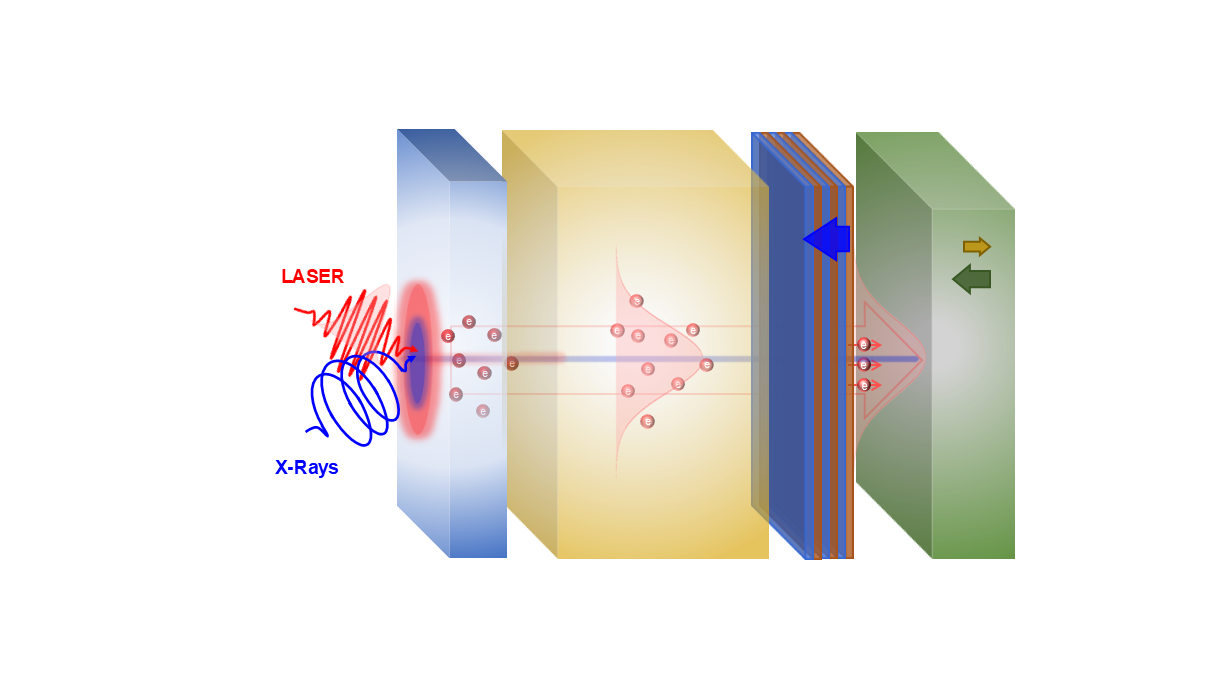
[The scheme shows (from left to right): Hot electrons generated by a laser in platinum (light blue), the copper (yellow) is used to block the laser pulse so that only the hot electrons propagate and transport a spin current through the magnetic spin valve structure of cobalt platinum (blue-brown) and iron gadolinium (green). The figure was prepared by author Deeksha Gupta (https://www.helmholtz-berlin.de/pubbin/news_seite?nid=30046;sprache=en).]
By applying an ultrashort laser pulse to a magnet, its magnetic order can be disrupted within a hundred femtoseconds! (1 fs=10-15 s.) This phenomenon, known as ultrafast demagnetization, was first observed almost 30 years ago in nickel thin films. It now holds promise for driving new technological developments in memory and spintronic devices. An international team of researchers from the University of Strasbourg (France), Helmholtz-Zentrum Berlin (Germany), Uppsala University (Sweden), University of Skövde (Sweden) and University of Lorraine (France) has dived into this phenomenon and, for the first time, observed experimentally some of the key dynamic processes in a magnetic layer system. Their findings, recently published in Nature Communications, are expected to contribute to the development of spintronic devices that allow for faster and more energy-efficient information processing and storage.
While conventional electronics rely on the movement of electric charge, spintronics makes use of a different property of electrons—their spin—to unlock new possibilities. Some of the advantages of spintronics over conventional electronics include lower power consumption, faster operation, non-volatility, and the potential for entirely new functionalities. These features not only improve performance but also contribute to greater sustainability in electronic devices. Spin is a quantum property of electrons that, among other things, contributes to magnetism in materials [¹ Not sure what magnetism is? See the note at the bottom of this page]. In this study, researchers looked at a type of spintronic device called a spin valve. It consists of two or more magnetic layers that conduct electricity. What is special about it is that its electrical resistance changes depending on how the magnetic directions² (or “moments”) of the layers are aligned. This makes spin valves useful in magnetic sensors and data storage technologies. The spin valve in this study was built using alternating layers of platinum-cobalt (Pt/Co) and an iron-gadolinium (FeGd) alloy (see featured image).
Experiment
Using a femtosecond infrared laser, the team excited electrons³ in the platinum top layer, creating so-called hot electrons. A thick copper layer was used to filter out unwanted effects, ensuring that only the hot electron pulses reached the Pt/Co layer at the front of the spin valve. This layer acted as a spin polariser, producing spin-polarised hot electron (SPHE) pulses. Due to the ultrafast timescales—on the order of femtoseconds—these processes are extremely challenging to observe and characterize. To achieve this, the team conducted experiments at BESSY II, a state-of-the-art synchrotron radiation facility in Germany.
Theory
Complementing the experimental work, a research team in Sweden performed advanced simulations using theoretical models developed by Professor Olle Eriksson of Uppsala University and WISE co-director, together with his collaborators. These simulations allowed them to determine key parameters of the SPHE pulses—specifically, their duration, spin polarisation direction, and the current densities needed to reproduce the experimental results.
– I enjoyed working on this project as part of an international team, featuring strong collaboration between theoretical and experimental researchers. During this investigation, we developed the models and collected the data that I plan to use to train AI models in my WASP-WISE NEST project, says Maryna Pankratova, researcher at Uppsala University and WISE-affiliated scientist.
This work has been published in Nature Communications:
”Tuning ultrafast demagnetization with ultrashort spin polarized currents in multi-sublattice ferrimagnets” by Deeksha Gupta, Maryna Pankratova, Matthias Riepp, Manuel Pereiro, Biplab Sanyal, Soheil Ershadrad, Michel Hehn, Niko Pontius, Christian Schüßler-Langeheine, Radu Abrudan, Nicolas Bergeard, Anders Bergman, Olle Eriksson and Christine Boeglin. Nature Communications 16, 3097 (2025).
To learn more about Maryna Pankratova’s research in WISE please visit:
Brain Inspired AI Design of Topological Magnets for Sustainable Computing
(*) Concepts discussed in the text:
¹ Magnetism
Some elements in nature—like iron, nickel, cobalt, and gadolinium—are naturally magnetic. This means they show what’s called ferromagnetism, a property that makes them attract or repel each other depending on the orientation of their magnetic poles. Ferromagnetism arises from the alignment of individual magnetic moments, which can be thought of as tiny bar magnets all pointing in the same direction. These magnetic moments are the result of both the orbital motion of electrons around the nucleus and the electrons’ intrinsic spin, and together they contribute to a material’s overall magnetization.
² Magnetic order
Depending on how the magnetic moments are arranged, different types of magnetic order can form. For example, if all the moments are aligned in the same direction, the material is a ferromagnet. If neighboring moments point in opposite directions, it is called an antiferromagnet.
³ Excited electrons
Electrons that have absorbed energy and moved to a higher energy level, away from their ground state.