Scientists classify fundamental particles into two groups—bosons and fermions—based on a quantum property called spin. Electrons belong to the fermion type. Professor Olle Eriksson from Uppsala University and WISE co-director, together with researcher Chin Shen Ong and colleagues from Columbia University (USA), Brookhaven National Laboratory (USA), Uppsala University (Sweden), Los Alamos National Laboratory (USA), the Max Planck Institute (Germany), Universidad del País Vasco (Spain) and the Flatiron Institute (USA), have recently investigated the behavior of so-called heavy fermions in the two-dimensional compound, CeSiI. Their results were recently published in Nature Physics.
Heavy fermions, explains Chin Shen Ong, researcher at Uppsala University, refers to electrons that, due to their interactions with other electrons, behave as if they were heavier than they would be without such interactions. In other words, their effective mass becomes much larger than that of a free electron. In materials where these interactions are weak, the increase is modest, typically around 1.5 times the free-electron mass. In the material examined in this study, the effect is dramatic: the electrons behave as if they are more than 100 times heavier. This unusual behavior can lead to phenomena such as superconductivity in certain heavy-fermion systems, and it remains an open question whether CeSiI might show related behavior under conditions not explored in this study. A material becomes superconducting when it can carry current without resistance, meaning that no energy is lost.
–Heavy fermions have been known since the mid-1970s in three-dimensional systems. Heavy-fermion-like behavior recently emerged in engineered two-dimensional heterostructures, while CeSiI provided the first example of a natural f-electron heavy-fermion state in two dimensions, says Ong.
A two-dimension heavy-fermion system
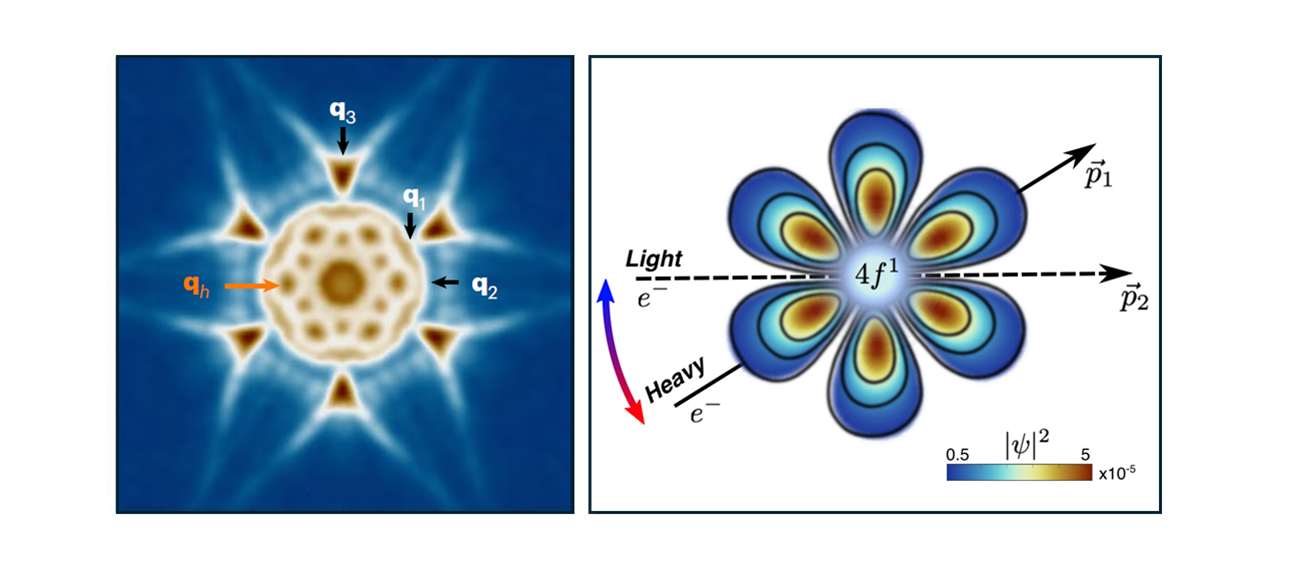
In their scientific article in Nature Physics, the researchers show that the reduced dimensionality of CeSiI creates a local electric field around the cerium atoms, that is strongly direction dependent. This environment isolates a specific f-electron state (Not sure what an f-electron is? Scroll down to learn more) buried deep inside the atom, where electrons interact strongly with one another.
The symmetry of that state controls how these localized f-electrons mix with the conduction electrons flowing through the material. This mixing—called hybridization—forms a nodal pattern: in some directions it drops to zero, letting electrons move freely and stay “light.” In other directions the hybridization is strong, causing the electrons to behave as if they were heavier. As a result, CeSiI hosts charge carriers that have effective mass varies dramatically depending on the direction they move.
–Ce-based systems continues to surprise us in their unique physical and chemical properties, and the current discovery certainly should be placed under WISE thematic area Discovery, with hope to become a key ingredient in applications for sustainability, says Prof. Eriksson from Uppsala University and WISE co-director.
This work brings together extensive experimental and theoretical efforts from a large international team. The study, titled Nodal hybridization in a two-dimensional heavy-fermion material, is authored by Simon Turkel, Victoria A. Posey, Chin Shen Ong, Sanat Ghosh, Xiong Huang, Asish K. Kundu, Elio Vescovo, Daniel G. Chica, Patrik Thunström, Olle Eriksson, Wolfgang Simeth, Allen Scheie, Angel Rubio, Andrew J. Millis, Xavier Roy and Abhay N. Pasupathy, and appears in Nature Physics (2025).
The article can be found at https://doi.org/10.1038/s41567-025-03060-y
An f-electron is an electron occupying an f-orbital, a type of atomic orbital characterized by its complex, multi-lobed shape, capable of holding up to 14 electrons, and found in the inner shells of heavier elements, particularly the lanthanides and actinides, leading to unique magnetic, electronic, and superconducting behaviors in f-electron materials.