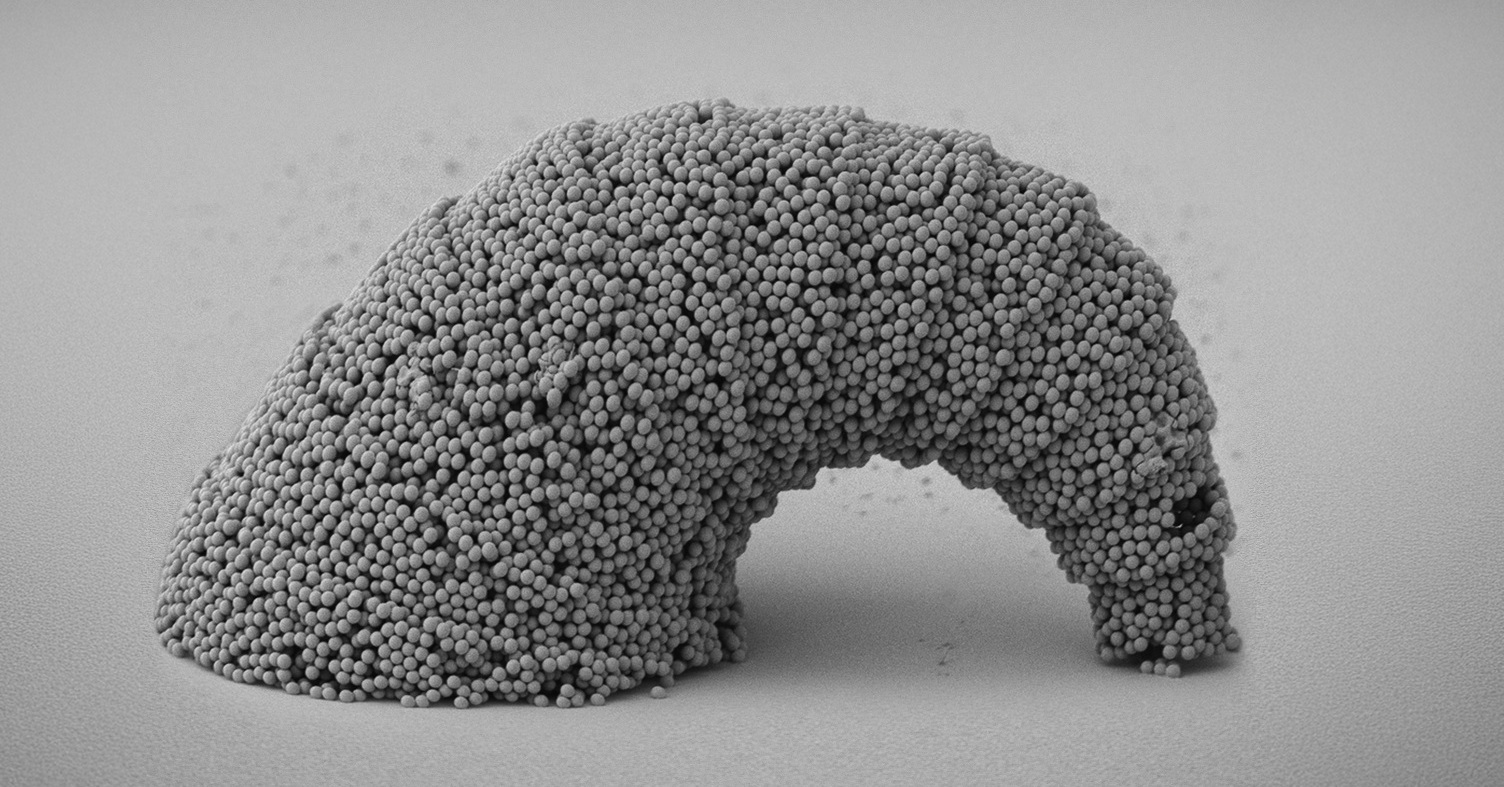
SEM images of a dangling croissant-shaped microstructure with a 3D curved surface assembled from SiO2 particles. Credit: MPI-IS.
Scientists are developing revolutionary methods to build ultra-small 3D structures—so tiny they are measured in millionths or even billionths of a meter. These breakthroughs are enabling the creation of miniature devices such as microrobots, microscopic actuators, and advanced nanoscale systems with applications across medicine, engineering, and robotics. Until recently, most advanced 3D micro- and nanofabrication techniques were limited to polymers (specialized plastics), restricting the range of materials that could be used. Now, an international research team has published a landmark study in the journal Nature demonstrating a state-of-the-art fabrication technique that overcomes these long-standing material limitations.
Moving Beyond Polymer-Only Fabrication
One of the most sophisticated existing methods, known as two-photon polymerization (2PP), works like an ultra-precise 3D printer that uses focused light to “draw” structures at the nanoscale. While it allows for extraordinary detail and complexity, it has historically been restricted to a narrow class of polymer materials.
The new approach changes this paradigm entirely.
Researchers from the Max Planck Institute, KTH Royal Institute of Technology, ETH Zürich, National University of Singapore and Koç University, developed a universal 3D micro-/nanofabrication strategy based on the direct assembly of material building blocks. Using a femtosecond laser inside a liquid environment, they generate highly localized thermal gradients and fluid flows. These forces precisely guide micro- and nanoparticles into pre-printed microtemplates, enabling light-driven assembly of complex 3D structures.
—This method allows the fabrication of structures made from a wide variety of materials, including metals, metal oxides, carbon nanomaterials, and quantum dots, sometimes even combined within a single structure, which removes the long-standing restriction to polymers, says Shervin Bagheri, professor in fluid dynamics at KTH and WISE-affiliated researcher.
Sustainability and Future Impact
This breakthrough introduces unprecedented flexibility in material choice for micro- and nanofabrication, opening the door to more sustainable, durable, and functional miniature devices. Such technologies are expected to play a crucial role in future advancements in biomedical devices, micro-robotics, nano-engineering, and advanced manufacturing.
The original publication can be found at:
Xianglong Lyu, Wenhai Lei, Gaurav Gardi, Muhammad Turab Ali Khan, Shervin Bagheri, Migchao Zhang and Metin Sitti,“Optofluidic three-dimensional microfabrication and nanofabrication”, Nature (2026) https://www.nature.com/articles/s41586-025-10033-x
To learn more about Prof. Bagheri’s research at WISE visit:
Self-organized liquid-infused materials for CO2 capture